
What Powers Does Congress Have Under the Constitution?
Enumerated Powers: What the Constitution Explicitly Grants
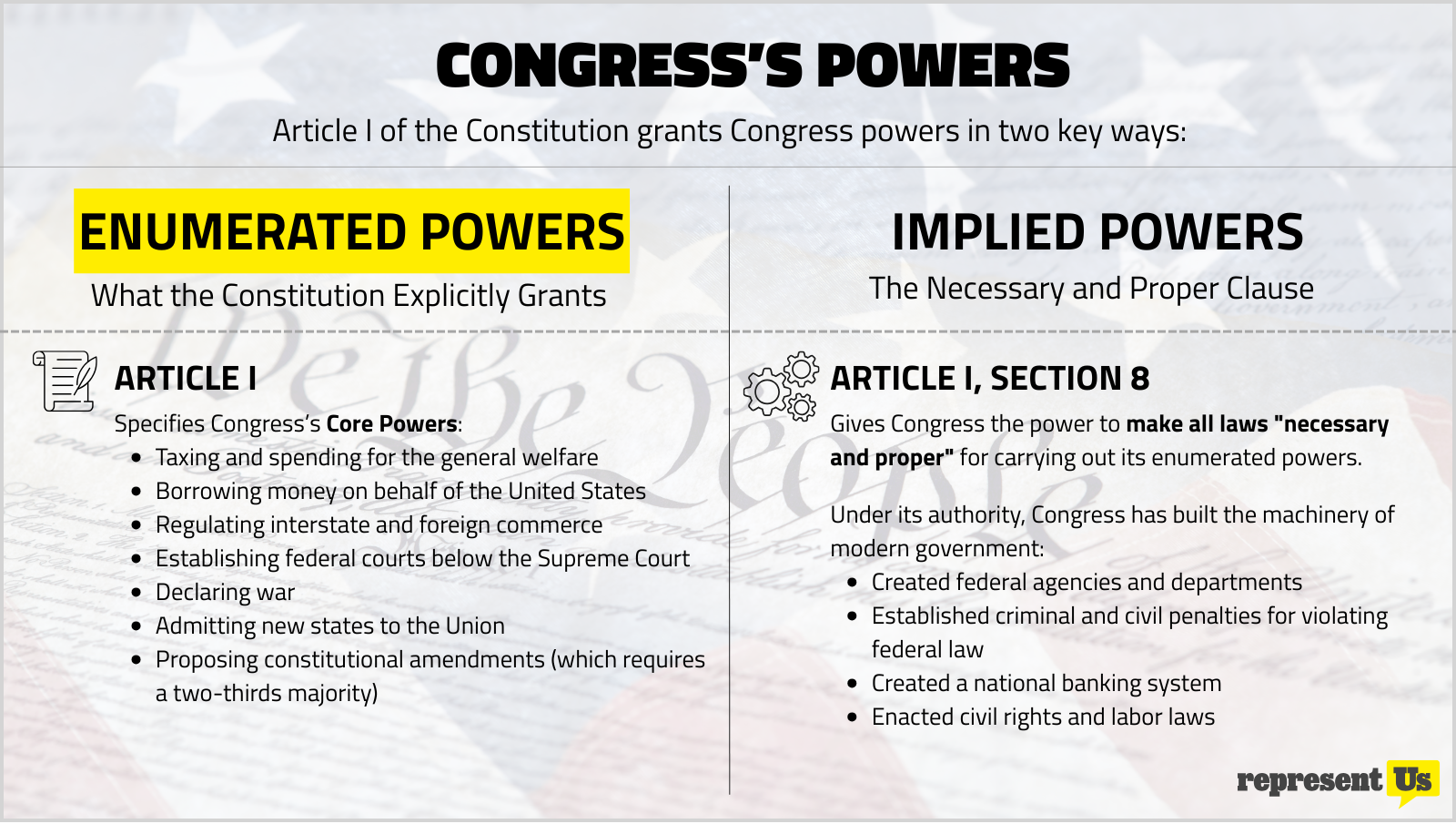
Article I of the Constitution lays out Congress’s core powers. These include:
- Taxing and spending for the general welfare
- Borrowing money on behalf of the United States
- Regulating interstate and foreign commerce
- Establishing federal courts below the Supreme Court
- Declaring war
- Admitting new states to the Union
- Proposing constitutional amendments (which requires a two-thirds majority)
Exclusive Powers of Each Chamber of Congress
The Constitution also gives each chamber of Congress some exclusive powers:
House of Representatives
- Sole power of impeachment (bringing charges against presidents, judges, or other officials)
- Originates all tax and spending bills
The Senate
- Sole power to try impeachments and vote on conviction and removal (requires two-thirds of Senators)
- Confirms presidential picks for federal courts and agencies
We’re leading the movement to make government more accountable to the people
Real-World Example: Congress’ War Powers on Paper vs in Practice
The Constitution splits war-making authority: Congress declares war and funds the military, while the president serves as commander in chief. The Framers were deliberate about gives Congress authority over the decision to go to war with the:
“The Executive is the branch of power most interested in war, and most prone to it” –James Madison, Fourth President, popularly known as “Father of the Constitution”
However, this balance has steadily eroded over time. Congress has formally declared war only 11 times, most recently in 1941. Since then, U.S. forces have fought in Korea, Vietnam, Iraq, Afghanistan, and dozens of other conflicts without a formal declaration.
Instead of formal declarations of war, presidents of both parties have committed troops by citing commander-in-chief authority or securing broad “authorizations for use of military force” that were far easier to stretch than a declaration of war.
The War Powers Resolution of 1973: Congress Tries to Take Back Control
After years of large-scale military involvement in Vietnam and across southeast Asia without a declaration of war, Congress passed the War Powers Resolution of 1973 over President Nixon’s veto. This legislation required the president to:
- Notify Congress within 48 hours of committing forces to hostilities
- Withdraw them within 60 to 90 days if there’s been no congressional authorization
In practice, it has not worked as intended: Every president since Nixon has questioned its constitutionality, and presidents have defined “hostilities” narrowly to avoid triggering the clock.
The 2001 Authorization for Use of Military Force, passed after the September 11 attacks, became another example of authority hollowed out over time—stretched by successive administrations to cover operations in 19 countries against terror groups, including a number of groups that didn’t exist in 2001, and still unrepealed more than two decades later.
💡Why does this matter? War powers are a textbook illustration of the difference between what Congress’s powers look like on paper and what they look like in practice. Through a combination of presidential expansion, broad legal interpretations, and Congressional acquiescence, the country has effectively given one person enormous discretion to commit U.S. forces in ways that can lead to major wars. As one analysis concluded, once Congress cedes this kind of power, it is “exceedingly difficult to take it back.”
Constitutional powers remain real only if Congress actively uses them.
Implied Powers: The Necessary and Proper Clause
Not all of Congress’s powers are explicitly spelled out in the Constitution.
Article I, Section 8 of the Constitution gives Congress the power to make all laws “necessary and proper” for carrying out its enumerated powers.
This clause has been one of the most consequential in the entire Constitution; it has enabled Congress to build the machinery of modern government.
Under this authority, Congress has:
- Created federal agencies and departments
- Established criminal and civil penalties for violating federal law
- Created a national banking system
- Enacted civil rights and labor laws
Landmark case: McCulloch v. Maryland (1819). When Congress created the first national bank, the state of Maryland challenged its constitutionality. The Supreme Court sided with Congress, ruling that the Necessary and Proper Clause allows Congress to use reasonable means to execute its constitutional duties—even when those means aren’t explicitly mentioned in the Constitution. This ruling helped establish the legal foundation for the Treasury Department and, eventually, the entire federal administrative state.
💡Why does this matter? The Necessary and Proper Clause has allowed Congress to adapt to a changing world. Without it, Congress’s powers would be frozen in the 18th century. With it, Congress can legislate for a complex modern economy and society—as long as the laws are connected to its core constitutional responsibilities.
How We Hold Congress Accountable
When Members of Congress avoid tough votes, defer to the executive branch, or ignore their oversight responsibilities, it’s up to us to hold them accountable.
We’re building a nationwide movement to push Congress to act with courage: to check the executive branch, defend the Constitution, and represent the people.
Our strategy is district-focused, expert-backed, and grassroots-led, and is designed to empower citizens to engage directly with their members of Congress, leading to real, lasting change.
Recommended Reading
Can the President Pardon Anyone?
Mar 31 2026
How Presidential Pardons Should Work, and How They Can Be Abused

What is Due Process?
May 29 2025
Constitutional rights aren’t privileges for the favored. They’re limits on government power. The moment we allow exceptions, we risk turning those exceptions into the rule.
Can Trump Serve a Third Term?
Apr 8 2025
President Donald Trump recently suggested he is considering ways to serve a third term, stating, “I’m not joking.”
How Big Money Took Over Politics
Apr 7 2025
Nearly $13 billion more is being spent on elections today than in 1998. This surge in election spending has ultimately led to politicians and government listening more to special interests and the wealthy few, at the expense of everyday Americans.
The Important Role of the Courts as a Check on Power
Mar 13 2025
Our judicial system plays an important but often overlooked role in the successful balance of power.
What exactly is an Executive Order?
Mar 3 2025
The president isn’t a king, and executive orders aren’t absolute. Our Constitution has a set of checks and balances to keep any one branch from becoming too powerful.
Is America Becoming a Kleptocracy?
Feb 15 2025
This question has become particularly pressing since the United States was recently classified as a backsliding democracy for the first time in its history.

What do inspectors general do?
Feb 10 2025
When the government falls short of serving the public’s interests, inspectors general (IGs) are there to act as safeguards against corruption, mismanagement, and inefficiency.