
How Congress Works:
Structure, Process, and Power
Congress is the branch of government responsible for making laws, controlling federal spending, and overseeing the executive branch.
But most people don’t see how it actually works day to day or how decisions really get made.
This guide breaks down how Congress is structured, how laws move (or don’t), and who in Congress has power.
At a Glance: What Congress Does
Congress has three core responsibilities:
- Makes federal laws
- Controls taxation and government spending
- Oversees the executive branch
When Congress does its job well, it:
- Acts as a guardrail against executive overreach
- Holds officials publicly accountable
- Ensures appropriated money is spent as intended
- Identifies fraud and abuse
- Translates public priorities into law
When Congress isn’t doing its job well:
- Presidents fill the gap with executive orders that can be easily reversed
- Courts are left to resolve disputes Congress could address
- Agencies operate under outdated or unclear rules
- Power shifts away from the branch most accountable to voters
We’re leading the movement to make government more accountable to the people
The Structure of Congress: Two Chambers, One Congress
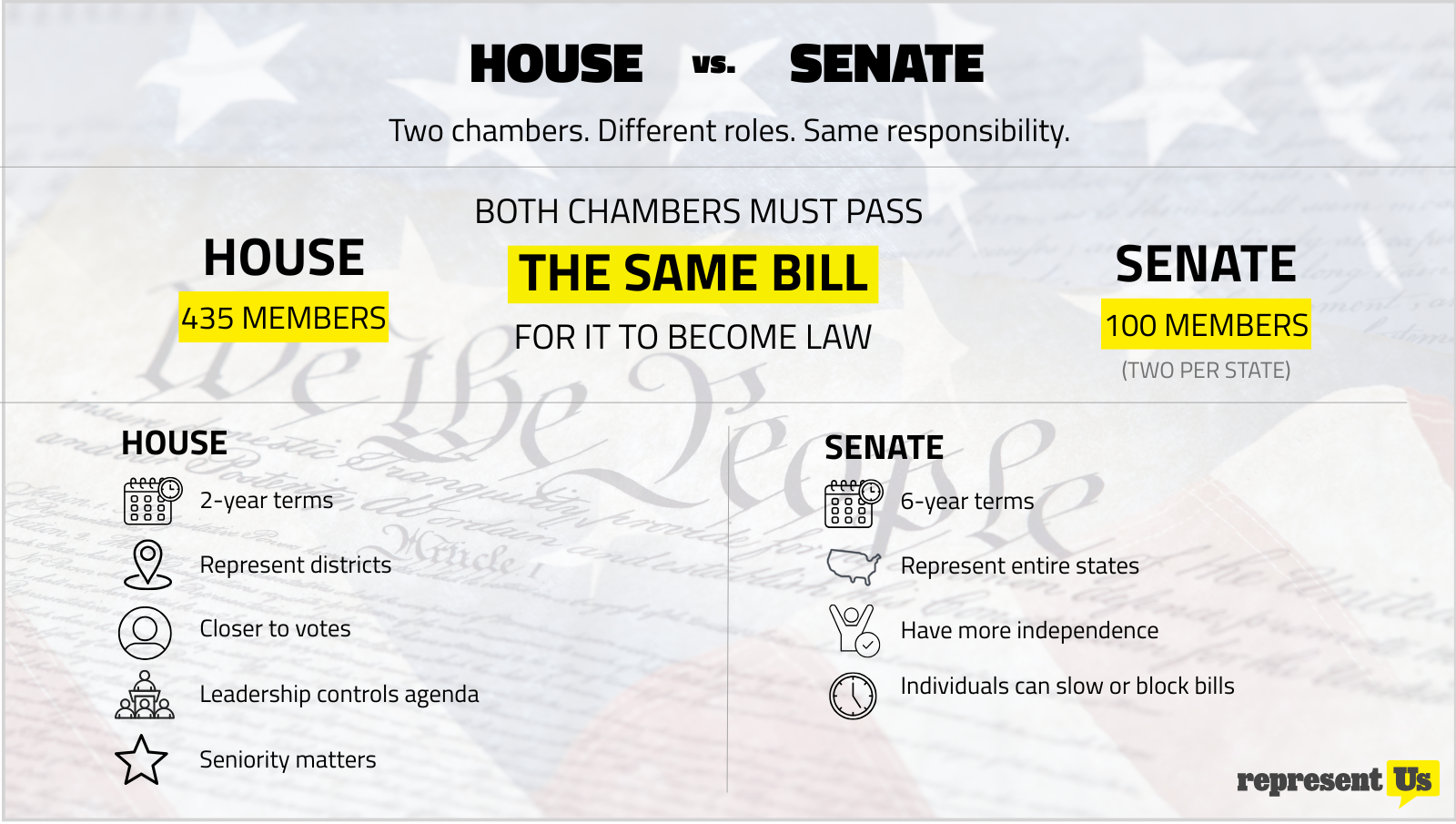
Congress has two chambers, the House of Representatives and the Senate. They have different rules, leadership structures, and procedures, but both must pass the identical version of a bill before it can become law.
The two chambers have distinct characters:
The House of Representatives
- 435 members
- Members sever two-year terms
- Represent specific districts
- More directly accountable to voters
- Closely attuned to local concerns
- Seniority has a lot of influence
- Leadership tightly controls what gets voted on
The Senate
- 100 members, two per state
- Members serve six-year terms
- Represent entire states
- More insulated from short-term political pressure
- Individual senators have significant power to slow or block legislation
💡Why does Congress have two chambers? The framers designed the two-chamber system deliberately, as a safeguard against any single body accumulating too much power. If one chamber passes something reckless or extreme, the other can block or fix it.
As future Supreme Court Justice James Iredell put it at the time: with two chambers, if a bill is wrong, “it is fortunate that there is another branch to oppose or amend it.” The flip side is that requiring agreement from both chambers—and then the President—makes major reforms genuinely hard to achieve.
That difficulty is a feature, not a bug. But it also means that when the two chambers cannot agree, nothing gets done—and the costs of that inaction fall somewhere else.
How Laws are Passed (and Stopped)
The House of Representatives and Senate each have different rules, leadership structures, and procedures, but both must pass the identical version of a bill before it can become law.
Once they do that, it goes on to the president who has 10 days to act. The President can:
- Sign it into law;
- Veto it and return it to Congress with objections
- Take no action—in which case the bill automatically becomes law if Congress is still in session.
There is also something called a “pocket veto”: if Congress adjourns before the 10 days are up and the president hasn’t signed a bill, the bill dies with no possibility of override.
Congress can override a presidential veto—but only with a two-thirds vote in both chambers, a very high bar. Historically, Congress has overridden only about 7% of all presidential vetoes.
Crucially, even the threat of a veto shapes legislation: presidents routinely signal what they will or won’t sign, and Congress often adjusts bill language to avoid a veto it can’t overcome.
Congressional Committees: Where the Real Work Happens
Most of the substantive work of Congress doesn’t happen on the floor—it happens in committees.
Standing and select committees will:
- Draft and amend legislation
- Hold hearings and gather testimony
- Conduct markups (line-by-line review of bills)
- Exercise oversight after laws are enacted
Members often serve on the same committees for years or even decades, building deep expertise in specific policy areas, and professional staff are provided to each committee to support legislative and oversight tasks.
Committee Leadership: The Power Behind the Scenes
Committee leadership controls what legislation advances, what oversight gets prioritized, and what issues get elevated on the government’s agenda.
A committee chair who refuses to hold hearings can effectively kill a bill or shield an agency from scrutiny. Who runs the committees matters enormously.
Real-World Example: The House Committee on Oversight and Government Reform
The House Committee on Oversight and Government Reform (HOGR) is one of the most powerful committees in Congress. Its mission is to ensure the efficiency, effectiveness, and accountability of the federal government and all its agencies—giving it jurisdiction over virtually the entire executive branch.
Unlike most committees, which focus on a specific policy area, HOGR has broad authority to
- Investigate waste, fraud, and abuse across government
- Hold hearings
- Issue subpoenas
- Propose reforms
Because its oversight reach is so wide, who chairs HOGR—and what investigations they choose to pursue (or not pursue)—has an outsized effect on executive branch accountability.

Understanding how Congress works is the first step. Holding it accountable is the next.
Congress is the branch closest to the people—we elect its members, and they serve us. When they avoid tough votes or neglect oversight, it’s up to us to hold them accountable.
That’s why we’re building a nationwide movement to push Congress to act with courage: to check the executive branch, defend the Constitution, and truly represent the people.
Recommended Reading
Can the President Pardon Anyone?
Mar 31 2026
How Presidential Pardons Should Work, and How They Can Be Abused
What is Due Process?
May 29 2025
Constitutional rights aren’t privileges for the favored. They’re limits on government power. The moment we allow exceptions, we risk turning those exceptions into the rule.
Can Trump Serve a Third Term?
Apr 8 2025
President Donald Trump recently suggested he is considering ways to serve a third term, stating, “I’m not joking.”
How Big Money Took Over Politics
Apr 7 2025
Nearly $13 billion more is being spent on elections today than in 1998. This surge in election spending has ultimately led to politicians and government listening more to special interests and the wealthy few, at the expense of everyday Americans.
The Important Role of the Courts as a Check on Power
Mar 13 2025
Our judicial system plays an important but often overlooked role in the successful balance of power.
What exactly is an Executive Order?
Mar 3 2025
The president isn’t a king, and executive orders aren’t absolute. Our Constitution has a set of checks and balances to keep any one branch from becoming too powerful.
Is America Becoming a Kleptocracy?
Feb 15 2025
This question has become particularly pressing since the United States was recently classified as a backsliding democracy for the first time in its history.

What do inspectors general do?
Feb 10 2025
When the government falls short of serving the public’s interests, inspectors general (IGs) are there to act as safeguards against corruption, mismanagement, and inefficiency.